ground-lease-in-amsterdam-(erfpacht)-the-plain-english-guide-every-buyer-needs
Ground Lease in Amsterdam (Erfpacht): The Plain-English Guide Every Buyer Needs
Share this article
When we first started helping expats buy homes in Amsterdam, there was one word that made almost everyone's eyes glaze over: erfpacht. Ground lease. It sounds like dry legal jargon, and most listings mention it in a single confusing line buried near the bottom. But here is the thing we tell every buyer we work with: erfpacht is not something to be scared of. It is something to understand. Once you know what the words mean, that one confusing line in a listing tells you almost everything you need to know about your future costs.
So let us walk you through it the way we would over coffee, before you fall in love with an apartment and forget to ask the important question.What Ground Lease Actually Is
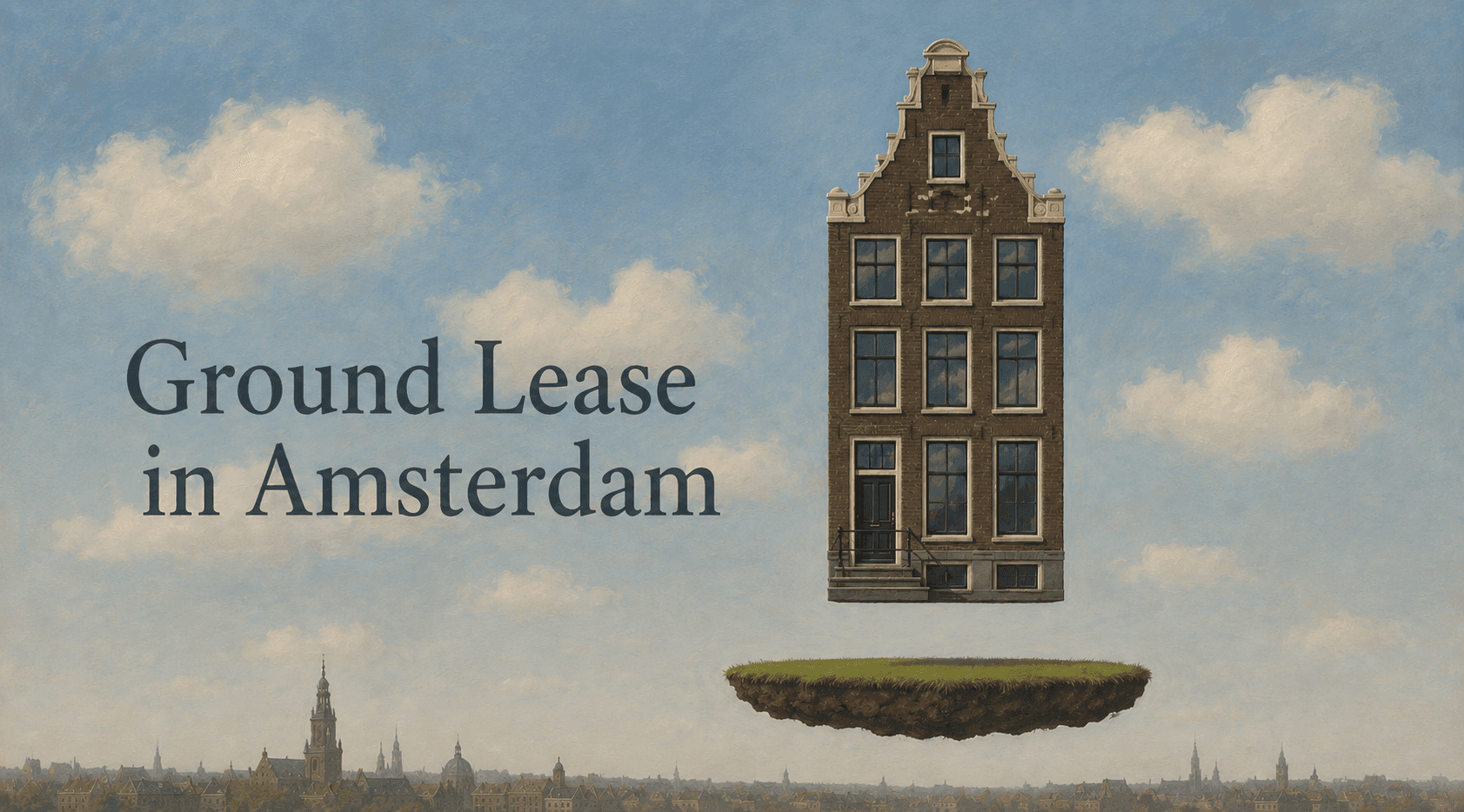
Here is the surprising part that catches almost every newcomer off guard. In Amsterdam, when you buy an apartment, you often do not own the land underneath it. Roughly 80 percent of homes in the city sit on land that belongs to the municipality. You buy the building, the right to live in it, sell it, and pass it on. But the ground itself stays with the city.
In exchange for using that land, you pay the city a fee. That fee is called the canon. The whole arrangement is called erfpacht, or ground lease.
This is not a trick or a hidden trap. It is simply how Amsterdam has worked since the 1890s, when the city decided to hold onto its land rather than sell it off. Plenty of perfectly happy homeowners live on leased land and never think about it. The reason it matters to you is purely financial: depending on which type of ground lease applies to the home you are buying, your future costs can range from absolutely nothing to a meaningful monthly bill on top of your mortgage. That is the difference you want to understand before you sign anything.
When you look at a listing, the ground lease situation will usually be described in one of a handful of ways. Let us go through every one of them, from the simplest to the ones that need a closer look.
1. Full Ownership (Eigen grond)
This is the gold standard, and the simplest situation of all. Eigen grond means "own land." You own the house and you own the land underneath it. There is no ground lease, no canon, no municipality involved, and nothing to ever pay or renew.
If a listing says eigen grond, you can breathe easy on this topic entirely. There are no extra costs now, and there never will be. It is exactly what most people from outside the Netherlands assume buying a home means.
These properties are a little less common in central Amsterdam, but they do exist, and when you find one, the absence of ground lease is a genuine plus. It also tends to help at resale, because the next buyer gets the same peace of mind you did.
2. Bought Off Forever (Eeuwigdurend afgekocht)
This is the next best thing, and in everyday life it feels almost identical to full ownership.
Here, the land technically still belongs to the municipality, but the previous owner paid off the ground lease permanently. The Dutch word eeuwigdurend means "perpetual," or "lasting forever," and afgekocht means "bought off." So the lease has been settled for eternity.
What this means for you is simple: there are no ongoing payments, no future renewal dates, and no recalculations to worry about. You inherit that paid-off status when you buy the home. For practical purposes, you can treat this almost the same as owning the land outright. It is one of the most reassuring things you can see in a listing.
A small note for the curious: there is a related version where the lease was switched to perpetual but the owner chose to keep paying an annual amount instead of buying it off entirely. That is a different situation, and it falls under the monthly payments chapter further down. The word that matters here is afgekocht. If it has been bought off, you are in the clear.
3. Paid Until a Specific Date (Afgekocht tot...)
This is where it gets a little more interesting, and where we slow down with our buyers.
A listing might say something like "afgekocht tot 31-08-2058," which means "paid off until 31 August 2058." The ground lease has been prepaid up to that exact date. Until then, you pay nothing at all. No canon, no monthly bill, nothing.
But that date is a real moment in your financial future. When it arrives, the lease has to be renewed, and the municipality recalculates the fee based on what the land is worth at that time. Because land values in Amsterdam have risen so much over the decades, that new fee can be a significant new cost, either as a monthly amount or as a lump sum to buy off the next period.
How much should you worry? It mostly depends on how far away the date is. If the lease is paid until 2065, that is decades away, and it should not weigh heavily on your decision today. If it is paid until 2032, that is close enough that you want to think carefully about what happens next and factor it into your longer-term budget. Either way, it is not a reason to walk away from a home you love. It is simply a number to write down and keep in mind.
4. Ongoing Monthly or Yearly Payments (Erfpachtcanon)
Sometimes you are buying into a situation where the ground lease is being paid as you go. The listing will show this clearly, with something like "€289 per month" or "€4,306.59 per year." This recurring fee is the canon, and you take over paying it when you buy the home.
This is the category that most directly affects what you can afford, because the canon sits on top of your mortgage payment every single month. A €289 monthly canon is effectively €289 of housing cost that has nothing to do with your loan. When we help buyers run their numbers, we always fold the canon into the real monthly figure so there are no surprises later. It also matters for your mortgage itself, because lenders take the canon into account when deciding how much they will lend you.
You will sometimes see the phrase "met afkoopmogelijkheid," which means "with option to buy off." This is good news. It means you have the choice to pay a one-time lump sum to settle the lease entirely, either for a fixed period or, in some cases, forever. Whether that makes sense depends on the size of the lump sum, how long you plan to stay, and how you are financing the purchase. There is also a nice detail worth knowing: the annual canon on your own home is currently still tax-deductible in the Netherlands, which softens the real cost a little.
One thing we want to be straight with you about. Over recent years, the city has been raising these canon amounts through annual indexation, and for many homeowners the increases have been steep. This does not affect homes that are already bought off forever, and it does not mean every canon is about to explode. But it is exactly why the small print matters, and why we read the actual ground lease conditions on any home with an ongoing canon before our buyers commit.
5. Long-Term Lease (Voortdurende erfpacht)
This is the older system, and the one behind most of the scary headlines you may have seen.
Voortdurende erfpacht translates roughly to "continuous" or "long-term" lease. The right to use the land continues over the long run, but it is divided into fixed periods, usually 50 or 75 years. During each period, your canon and your conditions stay the same, which feels stable and predictable. The catch comes at the end of the period.
When a period expires, the municipality has the right to recalculate the canon based on the current value of the land. Because Amsterdam land has appreciated so dramatically over half a century, that recalculation can produce a very large jump. This is the mechanism that occasionally turns a modest annual fee into a much bigger one overnight, and it is the reason this older system has caused so much anxiety in the city.
If you are looking at a home under voortdurende erfpacht, the key questions are simple: when does the current period end, and how close is that date? A renewal that is decades away is far less pressing than one coming up soon. Some lenders have also grown cautious about homes where the period expires within roughly ten years and no perpetual offer has been accepted, so this is one where we look closely at the specific dates and conditions before you make an offer.
6. Municipal Ownership Encumbered With Long-Term Lease
This is a more formal phrase you will sometimes see in legal descriptions, but it does not describe anything new. It is simply a precise way of saying that the city owns the land and a long-term lease sits on top of it.
In other words, this is the same situation as voortdurende erfpacht described in legal language. The land is owned by the municipality (the "municipal ownership" part), and your right to use it comes through a long-term lease arrangement that encumbers, or attaches to, that ownership ("encumbered with long-term lease").
If you spot this wording in a deed or a listing, treat it exactly as you would a long-term lease. The same questions apply: who owns the land, what is the canon, when does the period end, and what happens at renewal. There is nothing extra to fear in the phrasing itself. It is just lawyers being thorough.
7. Use and Occupancy (Gebruik en bewoning)
This one is genuinely uncommon, and it works a little differently from the others.
Use and occupancy, or gebruik en bewoning, gives you the right to use and live in a property, but under different legal terms than a standard ownership-style ground lease. Rather than holding a full leasehold right that you can freely deal with, you hold a more limited right tied specifically to using and occupying the home.
Because these arrangements are rare and the exact terms vary from case to case, this is not one to generalise about. If a property comes with a use and occupancy arrangement, we always read the specific conditions carefully to understand exactly what you can and cannot do, what it costs, and how it affects resale. It is not necessarily a problem, but it is the kind of detail you never want to discover after signing rather than before.
A Note on Timing in 2026
If you have been reading Dutch property news, you may have noticed a lot of noise about ground lease lately. Here is the short version, without the drama.
The municipality runs an annual increase on the cost of buying off a lease, based on inflation plus a fixed percentage. There was a meaningful deadline in December 2025 for existing owners to lock in more favourable terms, and that particular window has now closed. For you as a buyer in 2026, the practical takeaway is straightforward: the type of ground lease attached to a home is now more financially important than ever. A property that is already bought off forever has real value precisely because someone already handled all of this. A property with an ongoing or soon-to-renew lease is not a bad buy, but it is one where the numbers deserve a proper look. The same home on own land versus a steep ongoing canon can differ noticeably in both monthly cost and resale value.
This is genuinely one of the areas where having someone in your corner who reads these conditions every week makes a difference.
The One Question to Ask Every Time
If you remember nothing else, remember this. For any home you are considering in Amsterdam, ask: what is the ground lease situation, and what will it cost me, now and in the future?
The answer falls into one of the buckets above. Own land or bought off forever means nothing to worry about. Paid until a date means note the date. An ongoing canon means add it to your monthly budget. A long-term lease means checking when the period ends. Anything unusual means read the fine print. That is the whole game.
We have walked many expats through exactly this, and the buyers who feel calm and confident at the signing table are always the ones who understood their ground lease before they made an offer, not after. Knowing this stuff in advance is what turns house hunting from something stressful into something genuinely exciting.
Share this article
Need help finding your Amsterdam home?
We've helped hundreds of expats find their new home. Book a free video call,
and let's talk about what you're looking for.
Free 30-min video call. No commitment